Flexibility After 40: Why It Declines and How to Get It Back
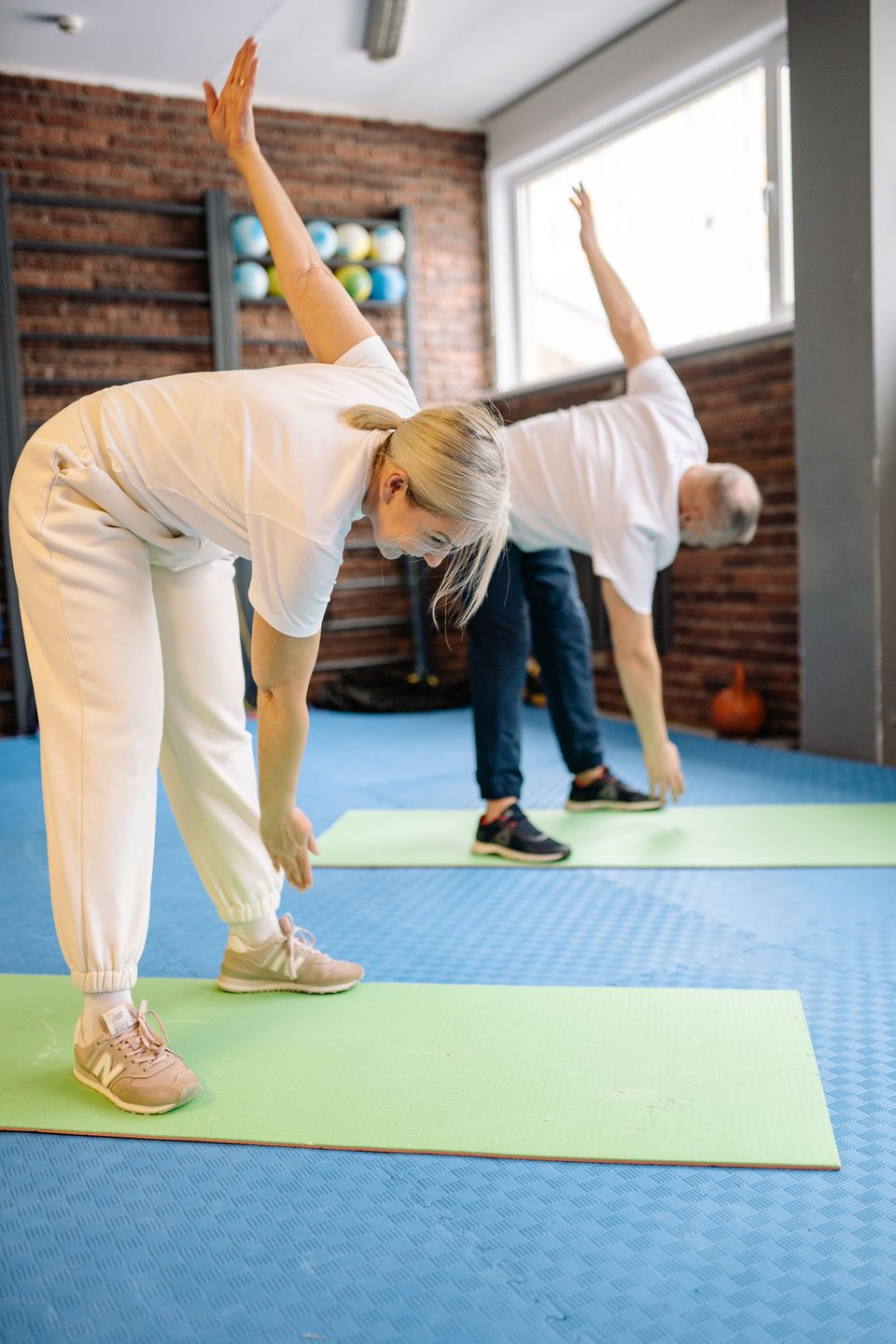
Flexibility after 40 declines not so much because of age as because we move through our full range of motion less and less. Here is how to regain mobility with simple exercises.
Flexibility after 40 declines gradually: bending down for something you dropped or reaching behind your back gets harder than it used to be. This isn't so much “age” as the result of years of sitting and tissues losing elasticity. The good news: flexibility can be trained, and you can regain a significant share of mobility within a few weeks of regular practice.
Why does flexibility decline after 40 in particular?
With age, connective tissue becomes less elastic, and muscles get used to the same position. Together, this means morning stiffness and a limited range of motion.
- Tendons, ligaments and joint capsules contain less elastin.
- Muscle fibers lose some of their elasticity.
- Years of desk work shorten the hip flexors, chest muscles and hamstrings.
Most of this stiffness is reversible with regular practice — as both Harvard Health Publishing and the National Institute on Aging point out.
How can you tell your flexibility has declined?
It usually shows in everyday things, not in whether you can do the splits. Watch for signs like these:
- it's hard to reach your shoelaces or feet without rounding your back;
- your body feels “stiff as a board” for the first half hour in the morning;
- it's hard to turn your head when backing out of a parking spot;
- your shoulders and chest feel “closed” and your back rounds by the end of the workday.
How to improve flexibility after 40: exercises that restore mobility
Simple exercises for the large muscle groups that get shortened from sitting work best. Do them smoothly, without bouncing, until you feel a light pull.
- Hamstring and calf stretches — the basic exercise against stiffness when walking and bending.
- Chest and shoulder stretches — especially important for people who spend a lot of time at a computer.
- Hip circles and leg swings — maintain the range of motion in your legs.
- Gentle spinal twists, seated or lying down — ease tension in the lower back.
Examples of flexibility exercises are in the NHS guidance. A detailed look at technique is in “Stretching before and after a workout”, and a short morning routine in “Morning stretches”.
How do you fit stretching into a normal day?
You don't need to set aside separate time: you can stretch for a few minutes in the evening while watching the news or right after your morning shower, when your muscles are warm. Consistency matters more than duration — 10 minutes every day does more than an hour once a week.
If you work at a desk, the tips in “Posture at the computer” will come in handy.
Flexibility or strength: which matters more after 40?
You need both: flexibility gives you range of motion, and strength gives you control and protects your joints within that range. The best results come from combining stretching with strength work, as described in “Strength training after 40”.
Regaining flexibility after 40: how to stretch so it works
Stretching works when it is smooth, regular and done on warm muscles. Bouncing and trying to “force” your range of motion are more likely to hurt than help.
- Warm up before stretching: a few minutes of walking or moving your arms and legs.
- Hold each position for 20–30 seconds, breathing calmly.
- Don't hold your breath or bounce at the end point.
- Compare yourself with where you were a month ago, not with other people's flexibility.
Over time, what used to be your limit becomes a comfortable middle of your range. Progress in flexibility is slow, but it lasts if you don't quit after the first few weeks.
How can you support an active lifestyle after 40?
Many people who train regularly also use LifeWave's X49 patch — according to the company, it is designed to support endurance and recovery after exercise. Together with X39 it comes in the X39 + X49 bundle: the company positions X39 for energy and overall wellbeing and X49 for activity and recovery. But regular exercise still makes the biggest contribution to mobility.