Nordic walking: technique, benefits and how to choose your poles
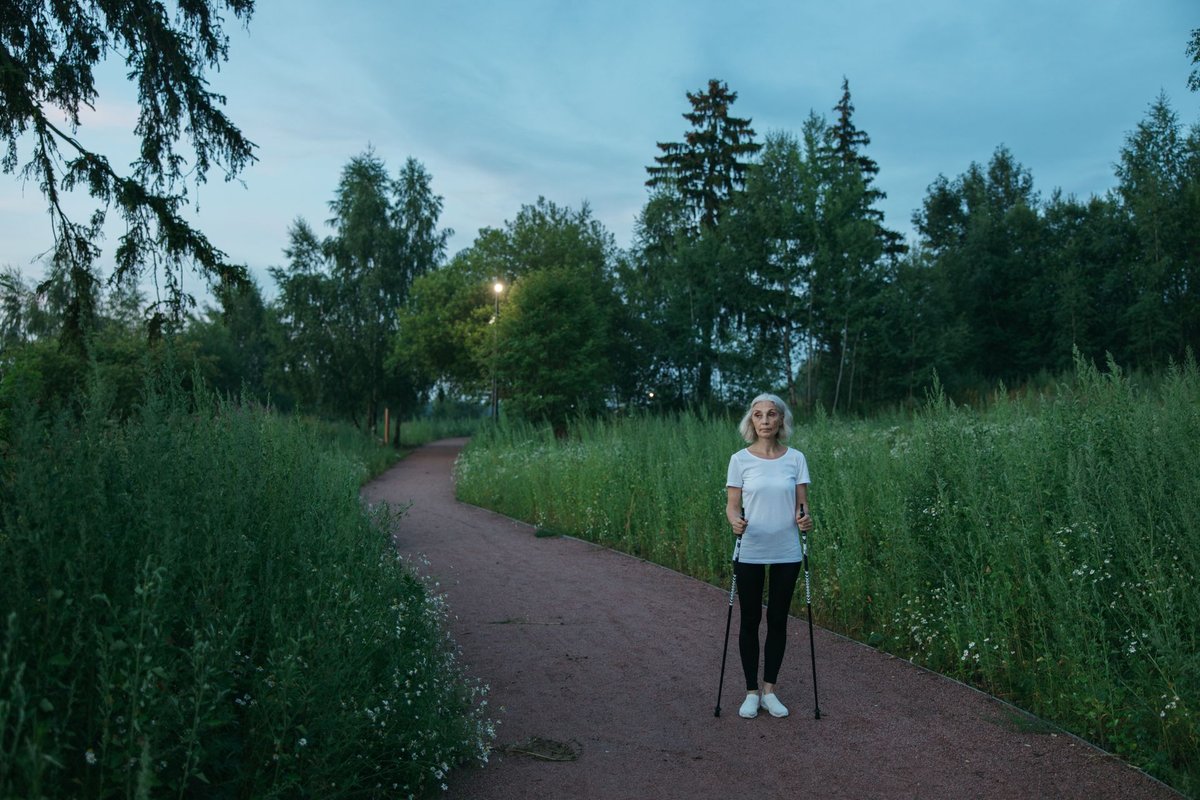
Nordic walking turns an ordinary walk into a full-body workout. Here's a look at the technique, the benefits and possible downsides, pole length and how a beginner can get started.
Nordic walking is brisk walking with poles that engage your arms, shoulders and back. It suits people of different ages and fitness levels, and you can start with 20–30 minutes in your local park. The key is proper technique and poles that fit your height.
The method comes from Finland and has long been popular in Germany and other European countries, and today you see it more and more in parks and on waterfronts around the world.
Nordic walking technique
The main thing is a natural stride with your arms swinging opposite your legs, just like in normal walking. The pole isn't just placed — it pushes you back and down.
- Your right arm swings forward with your left leg, and vice versa.
- Plant the pole at an angle, roughly level with the middle of your stride, with the tip pointing back.
- Push off with the pole and open your hand slightly at the end of the movement; shoulders relaxed, back straight.
- Your stride is slightly longer than usual, and your foot rolls from heel to toe.
- SportMedBC recommends taking a lesson from a certified instructor to start: proper technique makes a big difference to the benefits.
Nordic walking benefits and downsides
The benefit is gentle, full-body exercise that's easy to adjust. Downsides usually come from poor technique, the wrong poles or starting too hard.
A systematic review in PubMed that combined 16 randomized and 11 observational studies found favorable effects of Nordic walking on resting heart rate, blood pressure, endurance and quality of life. According to the authors, it outperformed brisk walking without poles on a number of measures.
What to avoid:
- poles that don't fit your height — they change your posture and overload your shoulders;
- "dragging" the poles without pushing off — then the arms do almost no work;
- sharply increasing time and pace in the first weeks.
The effort is easy to adjust: walk faster, push harder, pick a route with hills. That's why it suits both beginners and people who are already fit.
What length Nordic walking poles do you need?
A good guide is about 70% of your height, according to SportMedBC; at 170 cm (5'7") that's roughly 115–120 cm. The check is simple: stand the pole upright next to your foot — your elbow should be bent at roughly a right angle.
- Telescopic poles are easy to adjust to your height and the terrain.
- Rubber tips work on pavement, sharp tips on dirt and snow.
- The straps should hold your hand snugly but comfortably.
Nordic walking for beginners: where to start?
Start with short walks on a flat path and focus on technique. Speed and distance will come later.
- First weeks — 20–30 minutes 2–3 times a week.
- Warm up for 5 minutes: shoulder circles, gentle bends, walking without poles.
- Add a few minutes each week rather than everything at once.
- After the walk, do some gentle stretching for your calves, thighs and shoulders.
- Take water if you're walking longer than half an hour, and choose comfortable shoes with good soles.
Who is Nordic walking especially good for?
People who want more movement without running or jumping. The poles give extra support, so many people feel more confident.
- People getting back into exercise after a break.
- Those who like walking with company: the pace lets you talk.
- Those who want to move more outdoors in any season.
Nordic walking is an extension of simple walking that's easy to fit into life at any age. Exercises for stability and balance are in "Balance and fall prevention", and a gentle routine for your joints is in "Joint mobility exercises after 55".
To make it easier to get out the door, many people choose Y-Age Carnosine — according to the company, it supports motivation to move; more in "Y-Age Carnosine patch". And for comfort in movement, IceWave patches.